
Archive

February 2026

Browsing

Gold and silver prices experienced declines early in the week, but ended higher.

The yellow metal closed the week at US$5,111.88 per ounce, while silver finished at US$84.65 per ounce, buoyed by reignited tariff uncertainty out of the US.

On Friday (February 20), the US Supreme Court stuck down tariffs put in place by President Donald Trump using the International Emergency Economic Powers Act. He quickly responded by announcing a new 10 percent global tariff and then increasing it to 15 percent, ramping up trade tensions.

Earlier in the week, Wednesday (February 18) brought the release of the US Federal Reserve’s latest meeting minutes, which show that although officials largely agreed with the January decision to hold interest rates steady, they aren’t aligned about the path forward as 2026 continues.

What’s received more attention is the Lunar New Year holiday.

Most Asian markets are closed for the occasion, and will reopen next week. I asked Ole Hansen of Saxo Bank about the significance of the closure, and he said that in his view, the more important question is what will happen when they’re back in business next week.

Here’s how he thinks that could play out:

‘I think … if they come back to more or less unchanged prices, they will see that probably as a buying opportunity. Simply — well, they probably hope that they might be able to pick it up cheaper in the absence. But if we can manage to hold these levels, then there could be a positive story building as we as we see China reopen.’

Hansen is bullish on gold this year, saying he sees it reaching US$6,000 in the next 12 months.

But interestingly, he has a different take on silver — he thinks the white metal’s upside could be limited by demand-side factors like substitution and higher supply from scrap material.

‘Gold over time can go to US$10,000, it can go to US$20,000 — it’s a monetary metal, which doesn’t really depend on demand from areas where demand could be negatively impacted with the price.

‘Silver hasn’t got that luxury. And that basically means if gold moves towards US$6,000, I would believe that — I would think that silver, at some point, will struggle to keep up, and we will see basically gold relatively outperform silver. But when that point, when that time comes, I can’t see. Again it’s very unclear, especially given the speculative demand, which can carry on for a while longer.’

I also heard this week from Christopher Aaron of iGold Advisor and Elite Private Placements, who has a much brighter outlook for silver — he said given that the metal has just broken out of a 45 year consolidation period, it still has much further to go:

‘Now that whole process, the 45 year consolidation breakout and now coming back, that is — for a number of people here — that is going to be a once-in-a-lifetime breakout. We’re talking a multi-generational breakout happening in silver right now. And it’s really important to — I mean, the bottom line is this: After 45 years of consolidation, a market doesn’t end just two months after a breakout and then kind of withering and petering out for the next 45 years. Again, that’s not how 45 year breakouts happen when we look back.’

Ultimately Aaron sees US$250 to US$350 as a reasonable price level for silver.

Bullet briefing — TSX Venture 50, BHP/Wheaton deal

Gold, silver dominate TSX Venture 50

The latest TSX Venture 50 list was released on Wednesday, with gold and silver juniors dominating. In fact, of the companies included, only three fall outside the mining sector.

The list ranks TSXV companies’ annual performance by market cap growth, share price performance and Canadian consolidated trading value. Taking the top spot was Santacruz Silver Mining (TSXV:SCZ,NASDAQ:SCZM), which had an impressive share price increase of over 1,100 percent.

As a group, the companies on the list delivered a share price increase of 431 percent.

We’ll have to wait and see whether these types of gains are repeated — or exceeded — in 2026, but the list definitely underscores the strength in gold and silver prices, and shows that their momentum is boosting not just the majors, but also the juniors.

BHP, Wheaton sign streaming deal

On the M&A side, BHP (ASX:BHP,NYSE:BHP,LSE:BHP) has entered into a long-term streaming agreement with Wheaton Precious Metals (TSX:WPM,NYSE:WPM).

Under the deal, which was signed by subsidiaries of BHP and Wheaton, BHP will receive an upfront payment of US$4.3 billion in exchange for the delivery of silver from the Peru-based Antamina mine, plus ongoing payments when metal is delivered. According to BHP, this is the most valuable streaming transaction to date based on upfront consideration received.

Antamina is a joint venture between commodities giants BHP, Glencore (LSE:GLEN,OTCPL:GLCNF), Teck Resources (TSX:TECK.A,TECK.B,NYSE:TECK) and Mitsubishi (TSE:8058,OTCPL:MSBHF), and Wheaton already has a silver stream in place with Glencore. Once the BHP arrangement closes, Wheaton will receive a combined 67.5 percent of the mine’s silver.

Securities Disclosure: I, Charlotte McLeod, hold no direct investment interest in any company mentioned in this article.

This post appeared first on investingnews.com

A government shutdown, big or small, is usually a front-and-center issue for lawmakers — but the most recent partial closure could be put on the back burner as Congress returns to several issues in Washington.

Senate Democrats and the White House are still at odds over funding the Department of Homeland Security (DHS), as the shutdown dragged into its 10th day. Neither side is budging, with the most recent concrete action coming early last week.

Trump, who proved pivotal in striking a funding truce with Senate Minority Leader Chuck Schumer, D-N.Y., in January, was not directly involved in recent negotiations. 

Trump has not had any ‘direct conversations or correspondence’ with congressional Democrats recently, White House press secretary Karoline Leavitt said, noting that the White House and its representatives have been handling the dialogue.

‘But, of course, Democrats are the reason that the Department of Homeland Security is currently shut down,’ she said. ‘They have chosen to act against the American people for political reasons.’ 

Senate Democrats offered a counter to the White House’s own counterproposal, which quickly was rejected as ‘unserious’ by Leavitt. It’s a peculiar instance, given that this is the third shutdown during Trump’s second term, and neither side appears to be in a particular rush to end it.

Senate Majority Leader John Thune, R-S.D., told Fox News Digital that there’s ‘some room for give and take’ in the negotiations, but remained firm in the GOP’s positioning against requiring Immigration and Customs Enforcement (ICE) agents from getting judicial warrants, unmasking or other reforms sought by Democrats that could increase risks for agents in the field.  

‘I felt like, you know, the last offer the White House put out there was a really — it was a good faith one, and it was clear to me that they’re attempting, in every way, to try and land this thing so we can get DHS funded,’ Thune said. 

Funding the agency will be a top priority for the upper chamber, but they’ll be delayed because of winter storms descending on the East Coast. The weather has caused the Senate to delay a vote on the original DHS spending bill until Tuesday night, ahead of Trump’s State of the Union address.

There are other issues that could get in the way of hashing out a deal, including a possible conflict with Iran and Trump’s desire to move ahead with tariffs without congressional approval.

Trump told reporters Friday that he was ‘considering’ a limited military strike against Iran, which already has riled up some in Congress, who are demanding that lawmakers get a say on whether the U.S. strikes.

Sen. Tim Kaine, D-Va., said in a statement that he has a war powers resolution to block an attack on Iran filed and ready, and challenged his colleagues to vote against it.

‘If some of my colleagues support war, then they should have the guts to vote for the war and to be held accountable by their constituents, rather than hiding under their desks,’ Kaine said.

On the heels of the Supreme Court’s ruling to torpedo his sweeping duties, Trump is considering bypassing Congress to move ahead with another set of global 10% tariffs.

That comes as some Republicans are quietly celebrating the end of the duties, and others are open to working with the administration on a path forward for trade policy.

On tariffs, a Republican aide told Fox News that the GOP was ‘waiting to see what POTUS does next.’

‘The State of the Union should be interesting,’ they said.

This post appeared first on FOX NEWS

President Donald Trump will deliver his first official State of the Union address of his second term Tuesday night before a joint session of Congress at the Capitol, as viewers watch for viral moments and headline-grabbing exchanges like those that have defined past speeches.

Here are the top five moments from past State of the Union addresses.

1. Reagan surprises the crowd with first-ever acknowledgment of a guest in the audience

It’s become commonplace in recent years for presidents to acknowledge guests in the audience during SotU addresses, but President Ronald Reagan’s 1982 address was the first time the practice was rolled out. 

Reagan’s speech came just weeks after Air Florida Flight 90 crashed into Washington’s 14th Street Bridge over the Potomac River shortly after taking off in an accident that killed 78 people. 

Three people survived the crash thanks to civilians on the ground who rushed to their aid, including Congressional Budget Office assistant Lenny Skutnik, who stripped off his shoes and clothes and dove into the frigid waters.

Reagan honored Skutnik in his speech, which made honoring people in the crowd a common theme in the years to come. 

‘Just two weeks ago, in the midst of a terrible tragedy on the Potomac, we saw again the spirit of American heroism at its finest — the heroism of dedicated rescue workers saving crash victims from icy waters,’ Reagan said. ‘And we saw the heroism of one of our young government employees, Lenny Skutnik, who, when he saw a woman lose her grip on the helicopter line, dived into the water and dragged her to safety.’

2. Speaker Pelosi tears up Trump’s 2020 speech

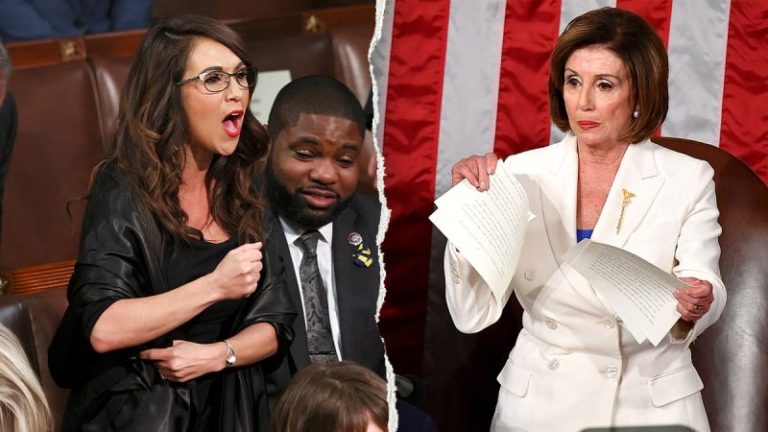
Democratic House Speaker Nancy Pelosi sparked a social media firestorm and cemented herself in State of the Union infamy in February 2020 when she stood up and tore Trump’s speech into pieces after he had finished.

When Fox News asked Pelosi afterward why she did it, she responded, ‘Because it was the courteous thing to do considering the alternatives.’ She added, ‘I tore it up. I was trying to find one page with truth on it. I couldn’t.’

Pelosi’s outburst came on the heels of Trump’s first impeachment trial, which ended in a Senate acquittal the day after the speech.

‘Speaker Pelosi just ripped up: One of our last surviving Tuskegee Airmen. The survival of a child born at 21 weeks. The mourning families of Rocky Jones and Kayla Mueller. A service member’s reunion with his family. That’s her legacy,’ the White House tweeted after Pelosi tore up the speech, referencing individuals who Trump mentioned during his address.

3. Rep. Joe Wilson ‘You lie!’ outburst at President Obama

One of the most remembered moments from a State of the Union address came in 2009 when South Carolina Republican Rep. Joe Wilson interrupted President Barack Obama’s address, which at the time was far less common than it later became. 

‘There are also those who claim that our reform effort will insure illegal immigrants,’ Obama said, talking about his controversial Obamacare plan. ‘This, too, is false. The reforms I’m proposing would not apply to those who are here illegally.’

‘You lie!’ Wilson shouted from his seat on the Republican side of the chamber, causing widespread yelling from other members in the audience.

Wilson later apologized to Obama’s chief of staff, Rahm Emanuel. 

‘This evening, I let my emotions get the best of me when listening to the president’s remarks regarding the coverage of illegal immigrants in the health care bill,’ Wilson said in a written statement. ‘While I disagree with the president’s statement, my comments were inappropriate and regrettable. I extend sincere apologies to the president for this lack of civility.’

4. Rep. Boebert heckles Biden over Afghanistan withdrawal during 2022 address

‘You put them in, 13 of them,’ GOP Rep. Lauren Boebert shouted at Biden as he talked about Afghanistan veterans who ended up in caskets due to exposure to toxic burn pits. Boebert was referencing the 13 U.S. service members killed during Biden’s chaotic withdrawal from Afghanistan in 2021. 

Boebert was wearing an outfit that said ‘Drill Baby Drill’ in opposition to Biden’s energy policies and her outburst drew some boos from the audience.

At another point, Boebert and Greene started chanting ‘build the wall’ when Biden was talking about immigration. 

5. President Biden blasts GOP lawmakers in 2023 address, prompting jeers from Republicans in the crowd

‘Some of my Republican friends want to take the economy hostage — I get it — unless I agree to their economic plans,’ Biden said to Congress, prompting a shake of the head from then-GOP House Speaker Kevin McCarthy in the background and shouts from the crowd and shots of other Republicans shaking their heads. 

‘Instead of making the wealthy pay their fair share, some Republicans, some Republicans, want Medicare and Social Security to sunset,’ Biden continued, which caused an even more pronounced shake of the head from McCarthy, who mouthed ‘no’ as Republicans continued to jeer. 

‘I’m not saying it’s the majority,’ Biden continued, which resulted in even more boos from the raucous crowd. 

‘Let me give you — anybody who doubts it, contact my office. I’ll give you a copy — I’ll give you a copy of the proposal,’ Biden continued to say over increasingly louder shouting from the crowd. 

‘That means Congress doesn’t vote — I’m glad to see — no, I tell you, I enjoy conversion,’ Biden said, apparently meaning to say ‘conversation.’

Biden’s speech continued to devolve from there as Republican outrage interrupted him on multiple occasions. 

This post appeared first on FOX NEWS

Los Angeles County filed a civil lawsuit against Roblox, alleging that the platform markets itself as a gaming experience for children but has created a ‘largely unsupervised online world’ that allows adults to mingle with minors with very little oversight.

The lawsuit says that Roblox’s architecture makes it easy for adults to masquerade as children in order to target them.

‘Beneath the bright animation and cheerful branding lies an environment in which child predators can readily locate, contact, and interact with minors through Roblox-enabled features and defaults, and where age-inappropriate sexual content and sexually themed interactions and experiences can be assessed and disseminated through Roblox’s functionality and tools, leaving minors to navigate dangers they do not and cannot understand,’ the lawsuit says.

The suit was filed on Thursday and asks that Roblox be ordered to pay a civil penalty of up to $2,500 for each violation of the Unfair Competition and False Advertising laws. It also asks that Roblox cover the county’s legal fees.

Roblox said in a statement that it disputes the county’s claims ‘and will defend against it vigorously.’

‘Roblox is built with safety at its core, and we continue to evolve and strengthen our protections every day,’ a company spokesperson said. ‘We have advanced safeguards that monitor our platform for harmful content and communications, and users cannot send or receive images via chat, avoiding one of the most prevalent opportunities for misuse seen elsewhere online.’

The company said safety remains a top priority and takes ‘swift action against anyone found to violate our safety rules.’

The lawsuit, however, accuses Roblox of failing to implement safety measures, including age verification, default communications restrictions and effective reporting mechanisms.

‘These fixes are obvious, easy, and long overdue,’ it says.

The county said in its suit that it has had to ‘expend, divert and increase resources to address rising rates of child sexual exploitation, trafficking, abuse and mental health trauma.’

‘By taking actions that increase the costs of law enforcement, child protective services, victim services, mental health counseling, and other public services, Roblox has diverted taxpayer dollars away from other critical public programs and services,’ the suit alleges.

Roblox said in its statement that as of January, it requires all users to undergo a facial age check to use the chat feature, and that chat users are placed into age groups.

Parents are given control over whether their child can access the chat feature, can block specific users and games, and can set screen time limits. The company also said it does not allow users to send images or videos via chat.

‘There is no finish line when it comes to protecting kids, and while no system can be perfect, our commitment to safety never ends,’ Roblox said.

Since its launch in 2006, Roblox has grown to become a massive global success. It has 144.5 million daily active users with over 35 billion engagement hours, its website states.

According to its most recent shareholder letter for Quarter 4, revenue grew 36% year-over-year to $4.9 billion and generated $1.8. billion in operating cash flow in fiscal 2025.

This was due to the addition of about 60 million daily active users from Quarter 4 of 2024 to Quarter 4 of 2025, the letter says.

Over the years, the gaming platform has been at the center of several lawsuits, including one filed last year where a California woman alleged that her teenage son was groomed and coerced to send explicit images on Roblox and Discord. The suit was filed after the boy took his own life in April 2024.

Attorneys for the mother said the boy was targeted by “an adult sex predator” who posed as a child on Roblox. The lawsuit alleged that the conversation between the boy and the man escalated to include “sexual topics and explicit exchanges.” The man eventually encouraged the boy to move the conversation to Discord, demanded that the boy share explicit videos and images, and then threatened to post them, the lawsuit alleged.

Both companies said at the time that it does not comment on legal matters. The case is still pending.

Louisiana Attorney General Liz Murrill also sued the platform last year, alleging that it was “the perfect place for pedophiles” due to its failure to implement strong safety protocols. Roblox denied her claims and said it was committed to working with the prosecutor’s office to keep children safe.

This post appeared first on NBC NEWS

Nuvau Minerals Inc. (TSXV: NMC,OTC:NMCPF) (the ‘Company’ or ‘Nuvau’) announces that, further to its news release dated January 30, 2026, it has amended the terms of its previously announced ‘best efforts’ brokered private placement offering, co-led by Clarus Securities Inc. and Integrity Capital Group Inc. (together, the ‘Agents’), comprised of (i) the offering of up to 18,750,000 units of the Company (the ‘Units’) at a price of $0.80 per Unit for gross proceeds of up to $15,000,000 (the ‘Unit Offering’) and the offering of up to 5,555,555 FT Shares (as defined herein) at a price of $0.90 per FT Share for gross proceeds of up to $5,000,000 (the ‘FT Offering’ and together with the Unit Offering, the ‘Offering’).

As amended, the Company proposes to issue up to 5,555,555 flow-through common shares of the Company (the ‘FT Shares‘) at an offering price of $0.90 per FT Share (the ‘FT Share Price‘). All FT Shares will be common shares of the Company that qualify as ‘flow-through shares’ within the meaning of subsection 66(15) of the Income Tax Act (Canada) and section 359.1 of the Taxation Act (Québec). The gross proceeds from the offering of FT Shares will be used by the Company to incur eligible ‘Canadian exploration expenses’ (as defined in the ITA), a portion of which may qualify as ‘flow-through mining expenditures’ and at least 30% of which will qualify as ‘flow-through critical mineral mining expenditures’ (‘FTCMME‘) (each as defined in the ITA) (the ‘Qualifying Expenditures‘). At the sole discretion of the Company certain subscribers of FT Shares may be allocated a higher percentage of Qualifying Expenditures that qualify as FTCMME. All Qualifying Expenditures will be incurred by the Company on or before December 31, 2027, and will be renounced in favour of the subscribers of the FT Shares with an effective date on or before December 31, 2026.

All other terms of the Offering remain unchanged. Please refer to the Company’s news release dated January 30, 2026, for additional information.

In connection with the Offering, a director of the Company, plans to sell up to 400,000 common shares of the Company (‘Common Shares‘) held, directly or indirectly, through the facilities of the TSX Venture Exchange (the ‘Exchange‘) and intends to use the proceeds from such sales to subscribe for 400,000 FT Shares under the FT Offering. The sale of such Common Shares is expected to be effected pursuant to pre-arranged trades made through the facilities of the Exchange.

Participation in the Offering by a director of the Company constitutes a ‘related party transaction’ within the meaning of Multilateral Instrument 61-101 – Protection of Minority Security Holders in Special Transactions (‘MI 61-101‘). The Company intends to rely on the exemptions from the formal valuation and minority shareholder approval requirements provided under sections 5.5(a) and 5.7(1)(a) of MI 61-101 on the basis that the fair market value of the transaction, insofar as it involves interested parties, will not exceed 25% of the Company’s market capitalization.

Closing of the Unit Offering is expected to occur on or about February 24, 2026, with the closing of the FT Offering expected to occur on or about March 6, 2026. Completion of the Offering remains subject to certain conditions, including, but not limited to, the conditional approval of Exchange. All securities issued under the Offering will be subject to a hold period expiring four months and one day from the date of issuance thereof.

The Agents will have an option (the ‘Agent’s Option‘), exercisable in whole or in part up to 48 hours prior to the closing of the Unit Offering, to offer for sale up to any combination of additional Units (or any combination of their underlying components) and/or additional FT Shares, at their respective offering prices, to raise up to an additional $5,000,000 in gross proceeds.

The securities offered have not been registered under the U.S. Securities Act, and may not be offered or sold in the United States absent registration or an applicable exemption from the registration requirements. This news release shall not constitute an offer to sell or the solicitation of an offer to buy nor shall there be any sale of the securities in any State in which such offer, solicitation or sale would be unlawful.

About Nuvau
Nuvau is a Canadian mining company, incorporated under the OBCA, currently in the exploration and development phase. Nuvau’s principal asset is its right to earn-in a 100% undivided interest from Glencore in the Matagami property located in Abitibi region of central Québec, Canada pursuant to an amended and restated earn-in agreement dated January 28, 2026, among Nuvau, Nuvau Minerals Corp., and Glencore.

Further Information
All information contained in this news release with respect to the Company was supplied by the respective party for inclusion herein, and each party and its directors and officers have relied on the other party for any information concerning the other party.

For further information please contact:
Nuvau Minerals Inc.
Peter van Alphen 
President and CEO
Telephone: 416-525-6063
Email: pvanalphen@nuvauminerals.com

Cautionary Statements
This news release contains forward-looking statements and forward-looking information (collectively, ‘forward-looking statements‘) within the meaning of applicable securities laws. Any statements that are contained in this news release that are not statements of historical fact may be deemed to be forward- looking statements. Forward-looking statements are often identified by terms such as ‘may’, ‘should’, ‘anticipate’, ‘will’, ‘estimates’, ‘believes’, ‘intends’ ‘expects’ and similar expressions which are intended to identify forward-looking statements. More particularly and without limitation, this news release contains forward-looking statements concerning the timing and ability of the Company to close the Offering on the terms announced, the proposed use of proceeds of the Offering, the Company’s ability to incur Qualifying Expenditures and renounce the Qualifying Expenditures to subscribers, and the Company’s ability to obtain exchange approval for the Offering. Forward-looking statements are inherently uncertain, and the actual performance may be affected by a number of material factors, assumptions and expectations, many of which are beyond the control of the Company, including expectations and assumptions concerning the Company and the Matagami Property. Readers are cautioned that assumptions used in the preparation of any forward-looking statements may prove to be incorrect. Events or circumstances may cause actual results to differ materially from those predicted as a result of numerous known and unknown risks, uncertainties and other factors, many of which are beyond the control of the Company. Readers are further cautioned not to place undue reliance on any forward-looking statements, as such information, although considered reasonable by the management of the Company at the time of preparation, may prove to be incorrect and actual results may differ materially from those anticipated.

The forward-looking statements contained in this news release are made as of the date of this news release, and are expressly qualified by the foregoing cautionary statement. Except as expressly required by securities law, the Company does not undertake any obligation to update publicly or to revise any of the included forward-looking statements, whether as a result of new information, future events or otherwise.

Neither the TSX Venture Exchange nor its Regulation Services Provider (as that term is defined in the policies of the TSX Venture Exchange) accepts responsibility for the adequacy or accuracy of this news release. No stock exchange, securities commission or other regulatory authority has approved or disapproved the information contained herein.

NOT FOR DISTRIBUTION TO U.S. NEWSWIRE SERVICES OR FOR DISSEMINATION IN THE UNITED STATES

To view the source version of this press release, please visit https://www.newsfilecorp.com/release/284780

News Provided by TMX Newsfile via QuoteMedia

This post appeared first on investingnews.com

For more than a month, Michal Weits has kept suitcases packed by the front door of her house in Tel Aviv.

‘We have our bags ready for weeks,’ she said. ‘Three weeks ago, there were rumors that it was the night the U.S. would attack Iran. At midnight, we pulled the kids out of their beds and drove to the north, where it is supposed to be safer.’

Weits, the artistic director of the international documentary film festival Docaviv, is speaking from her own traumatic experience. During the 12-day war, an Iranian missile struck her Tel Aviv home. She, her husband, and their two young children were inside the safe room when it collapsed on her.

‘After an Iranian missile hit our home and we lost everything we had, we also lost the feeling of ‘it won’t happen to me,’’ she said. ‘We are prepared, as much as it’s really possible.’

Weits remembers the surreal contrast of those days. Four days after being injured in the missile strike, while still in the hospital, she was told she had won an Emmy Award for the documentary she produced about the Nova massacre on Oct. 7.

‘Four days earlier an 800-kilogram explosive missile fell on our home and I was injured, and four days later I woke up on my birthday to news that I had won an Emmy,’ she said. ‘It can’t be more surreal than this. That is the experience of being Israeli, from zero to one hundred.’

She says Israelis have learned to live inside that swing. ‘Inside all of this, life continues,’ she said. ‘Kids go to school, you go to the supermarket, Purim arrives and you prepare, and you don’t know if any of it will actually happen. We didn’t make plans for this weekend because we don’t know what will happen.’

That gap — between visible routine and private fear — defines this moment. The fear she describes is now part of the national atmosphere.

On the surface, Israel looks normal. The beaches are crowded in the warm weather. Cafés are full. The Tel Aviv Stock Exchange has risen in recent days. Children go to school as Israelis prepare for the Jewish holiday of Purim and costumes are being prepared.

But inside homes and across local news broadcasts, one question dominates: when will it happen? When will President Donald Trump decide whether to strike Iran — and what will that mean for Israel?

Prime Minister Benjamin Netanyahu has instructed the Home Front Command and emergency services to prepare for possible escalation, with Israeli media reporting a state of ‘maximum alert’ across security bodies.

Speaking at an officer graduation ceremony this week, Netanyahu warned Tehran: ‘If the ayatollahs make a mistake and attack us, they will face a response they cannot even imagine.’ He added that Israel is ‘prepared for any scenario.’

The military message was echoed by the IDF. ‘We are monitoring regional developments and are aware of the public discourse regarding Iran,’ IDF Spokesperson Brig. Gen. Effie Defrin said. ‘The IDF remains vigilant in defense, our eyes are open in every direction and our readiness in response to any change in the operational reality is greater than ever.’

Yet the psychological shift inside Israel goes deeper than official statements.

For years, Israelis lived with rockets from Hamas. The Iranian strikes felt different.

‘The level of destruction from Iran was something Israelis had not experienced before,’ said Israeli Iran expert Benny Sabti. ‘People are used to rockets from Gaza. This was a different scale of damage. It created real anxiety.’

Iron Dome, long seen as nearly impenetrable, was less effective against heavier Iranian missiles. Buildings collapsed. Entire neighborhoods were damaged.

‘People are still traumatized,’ Sabti said. ‘They are living on the edge for a long time now.’

At the same time, he stressed that the country is better prepared today.

‘There are feelings, and there are facts,’ Sabti said. ‘The facts are that Israel is better prepared now. The military level is doing serious preparation. They learned from the last round.’

The earlier wave of protests inside Iran had sparked hope in Israel that internal pressure might weaken or topple the regime. Weits told Fox News Digital, ‘I am angry at the Iranian government, not the Iranian people. I will be the first to travel there when it’s possible. I hope they will be able to be free — that all of us will be able to be free.’

Despite losing her home and suffering hearing damage from the blast, she says the greater loss was psychological. ‘There is no more complacency,’ she said. ‘The ‘it won’t happen to me’ feeling is gone.’

Across Israel, that sentiment resonates.

This post appeared first on FOX NEWS

Steadright Critical Minerals (CSE:SCM) is a Canadian-listed exploration and development company focused on unlocking value from Morocco’s mineral-rich terrain. It prioritizes assets with past production, strong geological datasets, and defined development pathways, aiming to shorten timelines, lower risk, and balance near-term cash flow with longer-term discovery upside.

Its core assets include the fully permitted, past-producing Goundafa polymetallic mine, the Copper Valley copper-lead-silver project in a proven mining district, and the TitanBeach heavy mineral sands project along Morocco’s Atlantic coast. A recent letter of intent with SilverLine Mining SARL could further strengthen the portfolio by adding a licensed, silver-focused asset, reinforcing Steadright’s strategy of acquiring high-quality, permitted projects.

Operating in Morocco—a jurisdiction known for modern mining legislation, strong infrastructure, and competitive fiscal incentives—Steadright benefits from a supportive mining environment. The company is led by an experienced management team with decades of global mining, exploration, and capital markets expertise, positioning it to advance its projects efficiently.

Company Highlights

  • Near-Term Production: The historic Goundafa Polymetallic mine is fully permitted with a legacy of high-grade zinc, lead, copper, silver, and gold production, Goundafa offers near-term, non-dilutive cash flow from historic stockpile sales under a binding processing agreement.
  • Diversified Portfolio: Fully permitted Goundafa Polymetallic mine (PbZn-Cu-Ag-Au), the Copper Valley CopperLead-Silver Project, SilverLine Mining Sarl (LOI) and the TitanBeach Heavy Mineral Sands
  • Strategic Moroccan Operations: Operating in a mining-friendly jurisdiction with modern legislation, strong infrastructure, and significant fiscal incentives including corporate tax exemptions.
  • Experienced Leadership: Management and technical teams bring decades of international mining, exploration, and capital markets experience.

This Steadright Critical Minerals profile is part of a paid investor education campaign.*

Click here to connect with Steadright Critical Minerals (CSE:SCM) to receive an Investor Presentation

This post appeared first on investingnews.com

When President Donald Trump announced ‘TrumpRx’ in early February, a weight I’ve carried my entire adult life suddenly lifted from my shoulders. The website offers life-saving medications at much lower prices than normal, based on the president’s promise to give Americans the same prescription drug costs as patients in other developed countries. I can personally attest that such equal treatment — a policy known as ‘most favored nation’ pricing — is urgently needed for people who struggle with chronic disease.

I’ve had debilitating asthma since I was a child. I’ve been able to manage it thanks to a prescription drug which blocks lung inflammation and keeps my airways open. The few times I’ve gone off the medication, I’ve ended up in the emergency room, unable to breathe. That nearly happened four years ago in what I thought was the worst possible place — on the other side of the world, unable to contact my doctors or go to my pharmacy.

My family and I were in Italy, on a trip to honor my mother. She had recently been diagnosed with cancer and my brother and I scheduled the trip in between her chemo treatments, when she would be well enough to travel. She had always wanted to go there with us. But in our rush to get two families and three little kids packed, I accidentally grabbed a nearly empty inhaler.

I realized my mistake a few days into the trip, when I looked at the inhaler and saw that I only had two doses left. I wasn’t just worried about my health, though, of course, that was paramount. I worried how I’d afford the drug if I even found it in Italy.

I’ve organized my professional life around access to insurance that covers my medication, given its longstanding retail price $600 for a month’s supply. For 25 years, I’ve grappled with denied coverage letters, premium tier prescription charts and the constant worry that we would have to cut back on necessities to get my medication. At the time, in Italy, I was already paying a few hundred dollars a month for the drug — a lot, but a bargain compared to its normal price.

But I had no choice. I had to get my medication. After a few minutes of searching, I found an Italian pharmacy across town. I walked there immediately, trying to control my racing thoughts of what might happen. I knew that if I couldn’t get the drug, I couldn’t get safely back to the U.S.

Fifteen minutes later, in tears I walked out, drug in hand. It cost me only 30 euros or about $35.

At first, I was both relieved and grateful. But by the end of the day, I was scratching my head. Why was it $600 in the U.S. while Italians could get it for next to nothing? In the days that followed, I discovered that the answer is beyond complicated.

It’s affected by everything from a lack of price transparency to the meddling of middlemen who jack up costs. It’s also true that foreign countries have been negotiating the prices of prescription drugs for decades, forcing Americans to cover the enormous cost of pharmaceutical development while they pay far below market prices.

Whatever the reason, the system doesn’t work for Americans. Brand name prescription prices in the U.S. are more than four times higher than prices in other wealthy countries. As many as 18 million Americans have struggled to buy the prescriptions they need in recent years.

I’m now using a generic version of the drug that costs significantly less. But that doesn’t change the fact that I, like many other Americans with chronic disease, have paid through the nose for decades on end, only to find the medication I needed in Italy for what seemed like pennies.

I wasn’t just worried about my health, though, of course, that was paramount. I worried how I’d afford the drug if I even found it in Italy.

Trump is fighting to fix this broken system. Before launching TrumpRx, he reached 16 deals with pharmaceutical companies to charge most-favored-nation prices. As a lifelong conservative, I’m typically uncomfortable with this kind of government intervention in the market. But other countries have already intervened and people like me have paid the price.

If pharmaceutical companies need the extra money, they should take it up with other countries that negotiated them down first. Then they could recoup their costs on the backs of others, not simply by charging more in the U.S. Bottom line, there’s no good reason why 340 million Americans should pay so much more than hundreds of millions of people who live in Europe and Asia.

I will always be grateful that my medication was so affordable in Italy back in 2022. It may very well have saved my life. But I’m even more grateful that President Trump is finally lowering prices for every American here at home.

This post appeared first on FOX NEWS

A South Korean court sentenced former President Yoon Suk Yeol to life in prison Thursday for leading an insurrection after declaring martial law in December 2024.

Yoon was found guilty of abuse of authority and masterminding the insurrection.

Yoon, 65, denied the charges and argued that he had presidential authority to declare martial law and that his action was aimed at sounding the alarm over opposition parties’ obstruction of government.

Prosecutors said in January that Yoon’s ‘unconstitutional and illegal emergency martial law undermined the function of the National Assembly and the Election Commission … actually destroying the liberal democratic constitutional order.’

Yoon’s attempt to impose martial law lasted roughly six hours, sparking mass street protests before parliament quickly voted it down.

Under South Korean law, masterminding an insurrection carries a maximum sentence of death or life imprisonment. Prosecutors hadsought the death penalty.

While courts last imposed a death sentence in 2016, South Korea has not carried out an execution since 1997.

Yoon is expected to appeal the ruling.

Yoon faces eight ongoing trial proceedings and was already given a five-year prison sentence last month in a separate case on charges including obstructing authorities’ attempts to arrest him following his martial law declaration. He has appealed that sentence.

Reuters contributed to this report.

This post appeared first on FOX NEWS

Markets don’t usually hit record highs, risk falling into bearish territory, and spring back to new highs within six months. But that’s what happened in 2025.

In this special mid-year recap, Grayson Roze sits down with David Keller, CMT, to show how disciplined routines, price-based signals, and a calm process helped them ride the whipsaw instead of getting tossed by it. You’ll see what really happened under the surface, how investor psychology drove the swings, and the exact StockCharts tools they leaned on to stay objective. 

If you’re focused on protecting capital, generating income, and sleeping well at night while still capturing the upside, this is a must-watch. Discover which charts deserve your attention now, what to ignore, and how to prep for the back half of 2025. 

This video premiered on July 23, 2025. Click on the above image to watch on our dedicated Grayson Roze page on StockCharts TV.

You can view previously recorded videos from Grayson at this link.