Author

admin

Browsing

Steadright Critical Minerals (CSE:SCM) is a Canadian-listed exploration and development company focused on unlocking value from Morocco’s mineral-rich terrain. It prioritizes assets with past production, strong geological datasets, and defined development pathways, aiming to shorten timelines, lower risk, and balance near-term cash flow with longer-term discovery upside.

Its core assets include the fully permitted, past-producing Goundafa polymetallic mine, the Copper Valley copper-lead-silver project in a proven mining district, and the TitanBeach heavy mineral sands project along Morocco’s Atlantic coast. A recent letter of intent with SilverLine Mining SARL could further strengthen the portfolio by adding a licensed, silver-focused asset, reinforcing Steadright’s strategy of acquiring high-quality, permitted projects.

Operating in Morocco—a jurisdiction known for modern mining legislation, strong infrastructure, and competitive fiscal incentives—Steadright benefits from a supportive mining environment. The company is led by an experienced management team with decades of global mining, exploration, and capital markets expertise, positioning it to advance its projects efficiently.

Company Highlights

  • Near-Term Production: The historic Goundafa Polymetallic mine is fully permitted with a legacy of high-grade zinc, lead, copper, silver, and gold production, Goundafa offers near-term, non-dilutive cash flow from historic stockpile sales under a binding processing agreement.
  • Diversified Portfolio: Fully permitted Goundafa Polymetallic mine (PbZn-Cu-Ag-Au), the Copper Valley CopperLead-Silver Project, SilverLine Mining Sarl (LOI) and the TitanBeach Heavy Mineral Sands
  • Strategic Moroccan Operations: Operating in a mining-friendly jurisdiction with modern legislation, strong infrastructure, and significant fiscal incentives including corporate tax exemptions.
  • Experienced Leadership: Management and technical teams bring decades of international mining, exploration, and capital markets experience.

This Steadright Critical Minerals profile is part of a paid investor education campaign.*

Click here to connect with Steadright Critical Minerals (CSE:SCM) to receive an Investor Presentation

This post appeared first on investingnews.com

When President Donald Trump announced ‘TrumpRx’ in early February, a weight I’ve carried my entire adult life suddenly lifted from my shoulders. The website offers life-saving medications at much lower prices than normal, based on the president’s promise to give Americans the same prescription drug costs as patients in other developed countries. I can personally attest that such equal treatment — a policy known as ‘most favored nation’ pricing — is urgently needed for people who struggle with chronic disease.

I’ve had debilitating asthma since I was a child. I’ve been able to manage it thanks to a prescription drug which blocks lung inflammation and keeps my airways open. The few times I’ve gone off the medication, I’ve ended up in the emergency room, unable to breathe. That nearly happened four years ago in what I thought was the worst possible place — on the other side of the world, unable to contact my doctors or go to my pharmacy.

My family and I were in Italy, on a trip to honor my mother. She had recently been diagnosed with cancer and my brother and I scheduled the trip in between her chemo treatments, when she would be well enough to travel. She had always wanted to go there with us. But in our rush to get two families and three little kids packed, I accidentally grabbed a nearly empty inhaler.

I realized my mistake a few days into the trip, when I looked at the inhaler and saw that I only had two doses left. I wasn’t just worried about my health, though, of course, that was paramount. I worried how I’d afford the drug if I even found it in Italy.

I’ve organized my professional life around access to insurance that covers my medication, given its longstanding retail price $600 for a month’s supply. For 25 years, I’ve grappled with denied coverage letters, premium tier prescription charts and the constant worry that we would have to cut back on necessities to get my medication. At the time, in Italy, I was already paying a few hundred dollars a month for the drug — a lot, but a bargain compared to its normal price.

But I had no choice. I had to get my medication. After a few minutes of searching, I found an Italian pharmacy across town. I walked there immediately, trying to control my racing thoughts of what might happen. I knew that if I couldn’t get the drug, I couldn’t get safely back to the U.S.

Fifteen minutes later, in tears I walked out, drug in hand. It cost me only 30 euros or about $35.

At first, I was both relieved and grateful. But by the end of the day, I was scratching my head. Why was it $600 in the U.S. while Italians could get it for next to nothing? In the days that followed, I discovered that the answer is beyond complicated.

It’s affected by everything from a lack of price transparency to the meddling of middlemen who jack up costs. It’s also true that foreign countries have been negotiating the prices of prescription drugs for decades, forcing Americans to cover the enormous cost of pharmaceutical development while they pay far below market prices.

Whatever the reason, the system doesn’t work for Americans. Brand name prescription prices in the U.S. are more than four times higher than prices in other wealthy countries. As many as 18 million Americans have struggled to buy the prescriptions they need in recent years.

I’m now using a generic version of the drug that costs significantly less. But that doesn’t change the fact that I, like many other Americans with chronic disease, have paid through the nose for decades on end, only to find the medication I needed in Italy for what seemed like pennies.

I wasn’t just worried about my health, though, of course, that was paramount. I worried how I’d afford the drug if I even found it in Italy.

Trump is fighting to fix this broken system. Before launching TrumpRx, he reached 16 deals with pharmaceutical companies to charge most-favored-nation prices. As a lifelong conservative, I’m typically uncomfortable with this kind of government intervention in the market. But other countries have already intervened and people like me have paid the price.

If pharmaceutical companies need the extra money, they should take it up with other countries that negotiated them down first. Then they could recoup their costs on the backs of others, not simply by charging more in the U.S. Bottom line, there’s no good reason why 340 million Americans should pay so much more than hundreds of millions of people who live in Europe and Asia.

I will always be grateful that my medication was so affordable in Italy back in 2022. It may very well have saved my life. But I’m even more grateful that President Trump is finally lowering prices for every American here at home.

This post appeared first on FOX NEWS

A South Korean court sentenced former President Yoon Suk Yeol to life in prison Thursday for leading an insurrection after declaring martial law in December 2024.

Yoon was found guilty of abuse of authority and masterminding the insurrection.

Yoon, 65, denied the charges and argued that he had presidential authority to declare martial law and that his action was aimed at sounding the alarm over opposition parties’ obstruction of government.

Prosecutors said in January that Yoon’s ‘unconstitutional and illegal emergency martial law undermined the function of the National Assembly and the Election Commission … actually destroying the liberal democratic constitutional order.’

Yoon’s attempt to impose martial law lasted roughly six hours, sparking mass street protests before parliament quickly voted it down.

Under South Korean law, masterminding an insurrection carries a maximum sentence of death or life imprisonment. Prosecutors hadsought the death penalty.

While courts last imposed a death sentence in 2016, South Korea has not carried out an execution since 1997.

Yoon is expected to appeal the ruling.

Yoon faces eight ongoing trial proceedings and was already given a five-year prison sentence last month in a separate case on charges including obstructing authorities’ attempts to arrest him following his martial law declaration. He has appealed that sentence.

Reuters contributed to this report.

This post appeared first on FOX NEWS

Markets don’t usually hit record highs, risk falling into bearish territory, and spring back to new highs within six months. But that’s what happened in 2025.

In this special mid-year recap, Grayson Roze sits down with David Keller, CMT, to show how disciplined routines, price-based signals, and a calm process helped them ride the whipsaw instead of getting tossed by it. You’ll see what really happened under the surface, how investor psychology drove the swings, and the exact StockCharts tools they leaned on to stay objective. 

If you’re focused on protecting capital, generating income, and sleeping well at night while still capturing the upside, this is a must-watch. Discover which charts deserve your attention now, what to ignore, and how to prep for the back half of 2025. 

This video premiered on July 23, 2025. Click on the above image to watch on our dedicated Grayson Roze page on StockCharts TV.

You can view previously recorded videos from Grayson at this link.

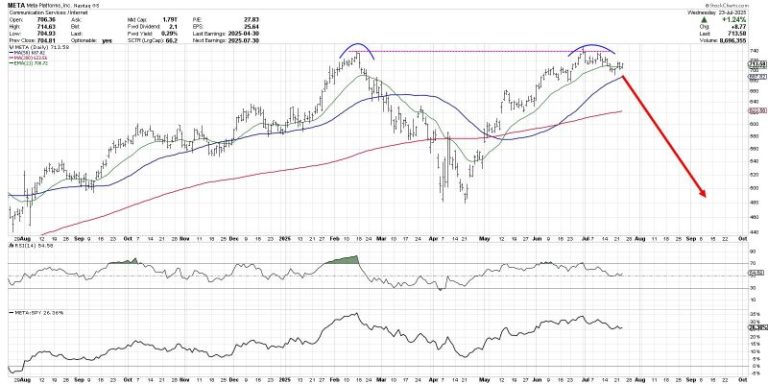
The chart of Meta Platforms, Inc. (META) has completed a roundtrip from the February high around $740 to the April low at $480 and all the way back again.  Over the last couple weeks, META has now pulled back from its retest of all-time highs, leaving investors to wonder what may come next.

Is this the beginning of a new downtrend phase for META?  Or just a brief pullback before a new uptrend phase propels META to new all-time highs?

Today we’ll look at two potential scenarios, including the double top pattern and the cup and handle pattern, and share which technical indicators and approaches could help us determine which path plays out into August.

The double top scenario basically means that the late July retest of the previous all-time high was the end of the recent uptrend phase.  The double top pattern is literally when a major resistance level is set and then retested.  The implication is that a lack of willing buyers means the uptrend is exhausted, and there is nowhere to go but down.

While the 21-day exponential moving average is currently in play for META, I would say that a break below the 50-day moving average could confirm this as the correct scenario.  If that smoothing mechanism does not hold, then the price action would imply less of a pullback and more like the beginning of a real distribution phase.

What is META pulls back but then resumes an uptrend phase, leading META to another new all-time high?  That would result in a confirmed cup and handle pattern, created by a large rounded bottoming pattern followed by a brief pullback.  The key to this pattern is the “rim” of the cup, which sits right at $740 for META.

Given the pullback META has demonstrated so far in July, I would say that a break above the $740 level would basically confirm a bullish cup and handle pattern.  That would suggest much more upside potential for META, as the stock would literally go into previously uncharted territory.

So how can we determine which scenario is more likely to play out?  This is where we need to incorporate more technical indicators into the discussion, as a way to further validate and confirm our investment thesis.

Just to review, I think a break above $740 would confirm a bullish cup and handle pattern.  I would also say that a break below the $680 level, which would represent a move below the 50-day moving average as well as the June swing lows, would basically confirm a bearish double top pattern.

We can also use the Relative Strength Index (RSI) to help determine whether META remains in a bullish trend phase.  During bull phases, the RSI rarely gets below 40, because buyers usually step in to “buy the dips” and keep the momentum fairly constructive.  So if the price would break down, and the RSI would not hold that crucial 40 level, that could mean a bearish outlook is warranted.

Finally, we can use volume-based indicators to assess whether moves in the price are supported by stronger volume readings.  Here I’ve included the Accumulation/Distribution Line, which tracks the trend in daily volume readings over time.  We can see that the high in July resulted in a divergence, as the A/D line was trending lower.  If the A/D line would break below its June and July lows, marked by a dashed red line, that would represent a bearish volume reading for META.

Technical analysis is less about predicting the future, and more about determining the most probable scenarios based on our analysis of trend, momentum, and volume.  I hope this discussion shows how the outlook for META can be easily determined and tracked using the best practices of technical analysis!

RR#6,

Dave

PS- Ready to upgrade your investment process?  Check out my free behavioral investing course!

David Keller, CMT

President and Chief Strategist

Sierra Alpha Research LLC

marketmisbehavior.com

https://www.youtube.com/c/MarketMisbehavior

Disclaimer: This blog is for educational purposes only and should not be construed as financial advice.  The ideas and strategies should never be used without first assessing your own personal and financial situation, or without consulting a financial professional.  

The author does not have a position in mentioned securities at the time of publication.    Any opinions expressed herein are solely those of the author and do not in any way represent the views or opinions of any other person or entity.

Is the market’s next surge already underway? Find out with Tom Bowley’s breakdown of where the money is flowing now and how you can get in front of it.

In this video, Tom covers key moves in the major indexes, revealing strength in transports, small caps, and home construction. He identifies industry rotation signals, which are pointing to aluminum, recreational products, and furnishings. Tom then demonstrates how to use StockCharts’ tools to scan for momentum stocks in emerging leadership groups — see why SGI tops Tom’s list. He ends with a discussion of post-earnings reactions from major names like GOOGL, TSLA, IBM, and LVS. 

And, of course, Tom wraps every idea with clear chart setups you can act on today. 

This video premiered on July 24, 2025. Click this link to watch on Tom’s dedicated page.

Missed a session? Archived videos from Tom are available at this link.

The S&P 500 ($SPX) just logged its fifth straight trading box breakout, which means that, of the five trading ranges the index has experienced since the April lows, all have been resolved to the upside.

How much longer can this last? That’s been the biggest question since the massive April 9 rally. Instead of assuming the market is due to roll over, it’s been more productive to track price action and watch for potential changes along the way. So far, drawdowns have been minimal, and breakouts keep occurring. Nothing in the price action hints at a lasting change — yet.

While some are calling this rally “historic,” we have a recent precedent. Recall that from late 2023 through early 2024, the index had a strong start and gave way to a consistent, steady trend.

From late October 2023 through March 2024, the S&P 500 logged seven consecutive trading box breakouts. That streak finally paused with a pullback from late March to early April, which, as we now know, was only a temporary hiccup. Once the bid returned, the S&P 500 went right back to carving new boxes and climbing higher.

New 52-Week Highs Finally Picking Up

If there’s been one gripe about this rally, it’s that the number of new highs within the index has lagged. As we’ve discussed before, among all the internal breadth indicators available, new highs almost always lag — that’s normal. What we really want to see is whether the number of new highs begins to exceed prior peaks as the market continues to rise, which it has, as shown by the blue line in the chart below.

As of Wednesday’s close, 100 S&P 500 stocks were either at new 52-week highs or within 3% of them. That’s a strong base. We expect this number to continue rising as the market climbs, especially if positive earnings reactions persist across sectors.

Even when we get that first day with 100+ S&P 500 stocks making new 52-week highs, though, it might not be the best time to initiate new longs.

The above chart shows that much needs to align for that many stocks to peak in unison, which has historically led to at least a short-term consolidation, if not deeper pullbacks — as highlighted in yellow. Every time is different, of course, but this is something to keep an eye on in the coming weeks.

Trend Check: GoNoGo Still “Go”

The GoNoGo Trend remains in bullish mode, with the recent countertrend signals having yet to trigger a greater pullback.

Active Bullish Patterns

We still have two live bullish upside targets of 6,555 and 6,745, which could be with us for a while going forward. For the S&P 500 to get there, it will need to form new, smaller versions of the trading boxes.

Failed Bearish Patterns

In the chart below, you can view a rising wedge pattern on the recent price action, the third since April. The prior two wedges broke down briefly and did not lead to a major downturn. The largest pullbacks in each case occurred after the S&P 500 dipped below the lower trendline of the pattern.

The deepest drawdown so far is 3.5%, which is not exactly a game-changer. Without downside follow-through, a classic bearish pattern simply can’t be formed, let alone be broken down from.

We’ll continue to monitor these formations as they develop because, at some point, that will change.

Here are some charts that reflect our areas of focus this week at


XLU Leads with New High

Even though the Utilities SPDR (XLU) cannot keep pace with the Technology SPDR (XLK) and Communication Services SPDR (XLC), it is in a leading uptrend. XLU formed a cup-with-handle from November to July and broke to new highs the last two weeks. ETFs hitting new highs are in strong uptrends and should be on our radar.


Metal Mania in 2025

In a tribute to Ozzy, metals are leading the way higher in 2025. The PerfChart below shows year-to-date performance for the continuous futures for 12 commodities. Copper, Platinum and Palladium are up more than 45% year-to-date, while Gold is up 28.38% and Silver is up 35.30%. QQQ is up 10.52% year-to-date, but lagging these metals. The other commodities are mixed.


Multi-Year Highs for Silver and Copper

The next chart shows 11 year bar charts for five metals. Gold broke out in early 2024 and led the metals move with an advance the last 21 months. Silver and copper broke out to multi-year highs. Platinum broke above its 2021 high and Palladium got in the action with an 18 month high. There is a clear message here: metals are moving higher and leading as a group.  


Home Construction Hits Moment of Truth

The Home Construction ETF (ITB) hit its moment of truth as it rose to its falling 40-week SMA. Notice that ITB failed just below this moving average in August 2023. During the 2023-2024 uptrend, the 40-week SMA was more friendly as ITB reversed near this level in October 2023 and June 2024. ITB surged to the falling 40-week SMA in July, but the long-term trend is down and this area could be its nemesis.

Thanks for Tuning in!

See TrendInvestorPro.com for more


Precious metals prices continued to face downward pressure this week as investors took strong US economic data and a changing geopolitical landscape into consideration.

After climbing to fresh all-time highs at the start of 2026, a myriad of factors in February have seemingly taken the sails out gold, silver and platinum prices. However, the underlying fundamentals for the precious metals remain strong, resulting in a resiliency that lends optimism to higher price points to come in 2026.

Let’s take a look at what got spot prices moving over the past week.

Gold price

Gold hit a record high of close to US$5,600 per ounce at the end of January before sliding into one of the largest price drops in decades, dipping as low as US$4,400 as February kicked off.

Over the past week, the metal has oscillated between slumps and cautious recovery. The spot price lost the battle to remain above the key US$5,000 mark in morning trading on February 12, falling to an intraday low of US$4,907.41. February 13 saw gold rebound slightly and trade in a tight range between US$5,000 and US$5,040.

Gold couldn’t hold that level on Monday (February 16), and the next day it began sliding below the US$4,900 support level. Wednesday (February 18) brought some relief, with gold once again fighting to stay above US$5,000.

Gold price chart, February 12, 2026 to February 18, 2026.

The primary drivers for gold this past week are:

      • Seasonal liquidity is also at play this week as the Lunar New Year holiday, which runs from February 16 to 23, typically results in lower trading volumes.

      In other gold news, the 2026 TSX Venture 50 list was released on Wednesday, with several gold companies named as top performers. The top five gold stocks on the list are: 1911 Gold (TSXV:AUMB,OTCQB:AUMBF), TDG Gold (TSXV:TDG,OTCQX:TDGGF), Omai Gold Mines (TSXV:OMG,OTCQB:OMGGF), Prospector Metals (TSXV:PPP,OTCQB:PMCOF) and Goldgroup Mining (TSXV:GGA,OTCQX:GGAZF).

      Silver price

      Silver has broadly tracked gold’s price movements over the past week.

      However, the white metal has exhibited significantly higher volatility, and the silver spot price is far outside of striking range of its all-time high of more than US$121 per ounce, which it reached on January 29.

      Silver fell by more than 9 percent on February 12 as it followed gold on the downtrend, falling from around US$83 to US$75. On Friday the 13th, silver managed not to scare investors as it traded mostly sideways at the US$77 level.

      For most of Monday and Tuesday (February 17), silver continued to limp along this trend line, but has managed to gain ground, rising from the US$75 level to an intraday high of US$78.24 as of 11:00 a.m. PST on Wednesday.

      Silver price chart, February 12, 2026 to February 18, 2026.

      In addition to the macro factors influencing gold, volatility in the silver market has also come from the ups and downs in the artificial intelligence (AI) sector. Silver, the most electrically and thermally conductive metal on the planet, is considered a key material for AI tech, particularly in data centers and high-performance computing.

      Over the past week, the Global X Artificial Intelligence & Technology ETF (NASDAQ:AIQ) has slid from approximately US$50.55 to US$49.94 as of midday on Wednesday, reflecting broader weakness in the sector.

      In other silver news, in its latest annual outlook, published on February 10, the Silver Institute reported that it expects macroeconomic and geopolitical conditions to remain broadly supportive for silver in 2026.

      Platinum price

      On February 12, platinum was trading as high as US$2,136 per ounce in early morning trading, but soon followed its precious metals sisters on a downward slide to an intraday low of US$1,982.50. The metal was back above US$2,070 the next day, and for the first part of this week it’s managed to trade above the US$2,000 level.

      Wednesday was a recovery day for platinum as it reached an intraday high of US$2,122.90 as of 11:00 a.m. PST.

      Platinum price chart, February 12, 2026 to February 18, 2026.

      Platinum is one of the top-performing metals over the past year, reaching 12 year highs in recent weeks. Demand is being driven by the metal’s essential role in the emerging hydrogen economy. It’s also still seeing robust demand from the auto sector despite the emergence of electric vehicles and uneasy consumer confidence in the economy.

      On the supply side, global platinum reserves remain critically low, especially as the world’s biggest producer, South Africa, continues to be plagued by power shortages and operational disruptions.

      This week, Johnson Matthey (LSE:JMAT,OTCPL:JMPLF), Sibanye-Stillwater (NYSE:SBSW) and Valterra Platinum (LSE:VALT,JSE:VAL,OTCPL:AGPPF) launched a multimillion-dollar partnership to develop new platinum-group metals clean energy and industrial technologies outside of the auto sector.

      Palladium price

      Palladium has been the black sheep of the precious metals family for the past few years, remaining well below its March 2022 all-time record of US$3,440.76 per ounce.

      On February 12 it followed the precious metals pack down from US$1,741 to as low as US$1,664.

      After a rebounding above to US$1,783 level on Monday, the following trading today brought much volatility to the metal, which traded in the US$1,670 to US$1,720 range. Platinum managed to to make gains to the upside on Wednesday with an intraday high of US$1,774 as of 11:00 a.m. PST.

      Palladium price chart, February 12, 2026 to February 18, 2026.

      The palladium price is being held down by a slump in demand for electric vehicles and a looming oversupply situation. Analysts at Heraeus Precious Metals predict that the palladium market may move into a surplus in 2026 as secondary supply from recycling increases by 10 percent.

      On that note, an announcement shaping the outlook for palladium on the supply side this past week came from the US Department of Commerce, which issued a preliminary statement of support for anti-dumping duties of approximately 133 percent on unwrought Russian palladium imports.

      This follows a petition from Sibanye-Stillwater over allegations that Russian metal is being sold in the US at less than fair value. A final decision is expected in the case by June of this year.

      Securities Disclosure: I, Melissa Pistilli, hold no direct investment interest in any company mentioned in this article.

      This post appeared first on investingnews.com

      Christopher Aaron, founder of iGoldAdvisor and Elite Private Placements, explains where gold and silver are in the current cycle and what his strategy looks like now.

      ‘This cycle is going to end in a mania,’ he said. ‘You want to position not when the mania is unfolding, but when it gets quiet, and I think we’re in one of those windows now to be positioning.’

      Securities Disclosure: I, Charlotte McLeod, hold no direct investment interest in any company mentioned in this article.

      This post appeared first on investingnews.com